Chapter 01 – Pages 25-28 Frisian Ancestors

25

THE SWARTWOUT CHRONICLES

who, by reason of the controversie they had with the territories thereabouts, were so blinded, as Jacob Hildebrand, bourgomaster, who was chicfe commander of the king’s chamber in Groningen, and the chicfe man in the city, and he, on whom they of the Reformed religion did chiefly relic, the evening before the city revolted to the [Spanish | king, supped with him | the Count of Renneberg. The bourgomaster told him very plainly of the report that men made of him, saying, that he hoped he had no such bad intention in him.

Whereupon the count wrung him by the hand, and said : What, my good father, whom I trust so well,have you such an opinion of me ? and withsuch like faire speeches smoothed the matter so well that the same evening the said bourgomaster, being in company with certain of the magistrates and those of the Reformed religion, assured them of the Count of Renncberi^’s s/ood meaning and intention towards them, and yet caused them of the Reformed religion to keep good watch in their owne houses, whereby they thought to be sufficiently assured.

But the Count of Renneberg’s practices being more and more suspected, he beo-an to feare that the Prince of Orange would enter Groningen with his guard, and therefore durst not protract his design any longer, although as then he was not sure of any reliefe.

For which cause, upon the second of March, he assembled his household servants and divers bourghers affected to the Spaniards, and certaine soldiers that he had kept secretly, and, in the morning (when by his espials he understood that the watch held by those of the Reformed religion were asleep), at five of the clock, being armed at all points, he rode from his house, followed by his adherents (every man having a white scarfe upon his left arm), into the market-place, and having his sword drawne in his hand, he said : Stand aside, stand aside, good bourgers, this day amIright governour of this city. Let us now accomplish and affect that Avhich is requisite for the king’s service and our owne defence ; and thereupon caused divers trumpets and drums to be sounded, and a oreat noise to be made.

The aforesaid bourgomaster Hildebrand, putting himselfe presently into armes with some of the Reformed religion, marched thither, and said unto him: How now, sire, is this done as a good governour ought to do unto the peo’

ple ? But then one of Count Renneberg’s boyes shot at him and slew him presently. Whereupon the rest [of the bourgomaster’s party] began to flic, whereof some were taken prisoners, and some fled into their houses ;but there were no more killed but only a bourger’s sonne of Breame.

After that they ran through the streets shooting at all who looked out at the windows. That done, they went and made search throughout all the city, and tooke all those prisoners who were not well thought of by the SpanishH

26 THE SWARTWOUT CHRONICLES.

affected bourgers, being at the least two hundred of the best citizens, whereof some were very hardly used, who notwithstanding-afterwards by divers meanes were set at liberty. Allthe preachers and divers other good bourgers got secretly away.”

Among those named as having been imprisoned were Albert Horenken, Harmen Koenink, Siger Sijghers, Joost van Cleve, Luilof Roelofs, and Roelof Battink of the Raadshcercii ;and Remmert Entens, Egbert Koenink, Hano Wijnge, Luitzen Hiddinge, Jan Bruins, Barend Hondebeke, and Johan Clood of the” Gezzvorcne Meente.

All these were immured in filthy, badly-ventilated cells by the count’s railing followers, bearing the name of the Smaller or Nearer Union. This having been done, he called before him the guilds, one by one, which, at his suggestion, bestowed upon him the transformed authority, or that thought reformed, to reconstruct the government, and consequently to install in power the good Romanist-inclined. Thereupon he allowed the reconciliation of the king to be confirmed and proclaimed.” 2

The intelligence of the Count of Renneberg’s secession and violence caused the city to be besieged immediately by the Count of Hohenlohe. A considerable portion of the royalist army having been sent by the Prince of Parma to its relief, under Martin Schenk (a deserter from the States^General’s party), he broke up his camp before the city, and marched to meet Schenk’s forces, near Hardenberg. He was somewhat superior in -numbers, yet his troops, being exhausted by a long march under a burning sun, were unable to sustain the vigorous onslaught of the royalists. Hohenlohe was defeated with considerable loss, and forced to retire within the walls of Olden” zaal.

The siege of Groningen being thus raised, the Count of Renneberg marched upon Delfzijl [eighteen miles northwest of the city), which, after a resistance of only three weeks, was disgracefully surrendered by a party of mutinous soldiers in the garrison. Lingen, Oldenzaal, and some other small places likewise fell into his hands; and having made a fruitless attempt upon Zwolle, he sat down before the small town of Steenwijk, in the province of Overijsel [about thirty-five English miles southwest of Groningen]. (See map, page 2.)

“Though strong by its natural situation, the fortifications of this town were in an incomplete condition, and many of the burgers were secretly inclined to the Spanish party ; yet the resistance offered by the garrison (of

1 A gcncrall historic of the Netherlands, pp. 732-734. Ed. Grimeston. Tegenwoordige staat der

Vercenigde Nederlanden. Stad en Landc. Twuitigste dccL pp. 489-493.

a Tegenwoordige stat der Yerecnidge Nedeilanden. Stad en Landc. Tzuintigste dccl. p. 492.

I

THE SWARTWOUT CHRONICLES. 27

six hundred infantry and a few horse), under Theodore Cornputtc, their commander, was no less gallant than that which the Prince of Parma had encountered at Maastricht [in the province of Limburg, in 1579]. Such was the firmness of the besieged, and so inefficient the condition of the artillery at this period, that a fortress, comparatively so insignificant, was enabled to hold out against the whole force of the Count of Renneberg, consisting of six thousand foot and twelve troops of cavalry, for a period of nineteen weeks.” 1

One of the most memorable incidents giving historical importance to the siege of Steenwijk, in 1580, was a courageous act of Arent Swartwolt, whose father, in 1581, was elected a courtier by the Bromvcrsgildc of Groningen. The fact that this loyal young soldier was then a member of the infantry company commanded by Captain Cornput undoubtedly justifies the assertion that not only was Arent Swartwolt’s father, but all his kinsmen in Groningen, including Johan Swartwolt, the Sworn Commoner, were patriotic supporters of the States-General, and consequently in personal disfavor with the Count of Renneberof.

It happened that the Count of Renneberg’s soldiers, occupying an earthwork opposite one of the gates of Steenwijk, having failed in preventing a sortie of a small body of the defenders of the place, who thereupon burned a

windmill standing dangerously near the gateway, were greatly exasperated, and, in a spirit of emulation, determined to burn a fence of heavy palisades protecting that particular gate. Having, on a dark night, in the month of October, compelled the sentinels guarding it to retire from an advantageous point of observation by keeping a constant fire of musketry upon it, they carried to the line of palisades a quantity of straw and a barrel of tar and brimstone, to which they set fire in order to ignite and consume the wooden barrier. Having accomplished the ignition of the protecting palisades, they hastily fled behind their earthworks with the loss of one man killed.

When the flames illumined the sky and the intention of the incendiaries was discovered, the extinguishment of the fire became a matter of immediate consideration and importance to the defenders of Steenwijk. Seeing the threatening character of the fierce flames, Arent Swartwolt solicited the privilege of making an attempt to quench them. It being granted him, he descended by a rope to the moat, and swam across it with the bail of a leathern bucket in his mouth. Unmindful of the blistering heat and the jeop ardy to which he was exposed, he rolled the barrel of burning tar and brimstone away from the palisades into the moat, and with water taken in the bucket from it, he extinguished the flames and saved the defensive barricade.

1 History of Holland. By C. M. Davics. London, 1842, vol. ii.,pp. 99, 100.

28 THE SWARTWOUT CHRONICLES.

An inviting target as he was for the bullets of the enemy’s muskets, he escaped without being hit by them, and was safely drawn to the top of the town-wall. His delighted comrades greeted his return with lusty cheers, and his proud captain honored him with a reward of no mean value. 1

The Count of Renneberg, disheartened by the adversities he had encountered while beleaguering Steenwijk, abruptly marched his forces, on February 23, 158 1, to Ommen, a small town in the province of Overijsel. Having in the early part of the summer of that year been defeated at Gripskerk by Sir John Norris, he was forced to retire to Groningen with the remnant of his army. In consequence of the hardships he was forced to endure while besieging Steenwijk, and the disappointment of his hopes of aggrandizement by the Spanish Government, he suddenly sickened, and died on July 23, 1581. Dur”

ing his sickness, it is said, he did often grieve and lament that he had quit the States-General’s party, whereby he had drawne himself into such a laba’

rynth, crying out often : O Groningen, Groningen, whereunto hast thou brought me!’ cursing the day he had ever scene it.’ As stadtholder of Groningen he was succeeded by Francis Verdugo, a Spaniard, whose lieutenant, Captain Lankama, was forced by Prince Maurice to surrender the city, on July 22, 1594. “The first care of the prince on entering Groningen was to clear the churches of images, and to cause the Reformed service to be celebrated in them.” 2

During the continuation of hostilities ending with the surrender of the city to the States-General, several members of the Swartwout family, residing there, were elected Sworn Commoners, and as such took part in electing the chief officers of the city. As disclosed by the municipal records “Herman Swart”

“wolt was a member of the Gczioorene Mceute in 1582, and again in 1583, and Johan Swartwolt “in 1587, 1559, and 1592. In the following century, the name of Herman Swartwolt is found enrolled among the members of that body, in the years 1631, 1632, and 1634.

1A general historie of the Netherlands. ByEd. Gihncston, p. 754.

IJ Ibid., pp. 776, 10S7-1094. History of Holland. By C. M. Davies, pp. 272, 273.

DIAGRAM OF THE CENTRAL PART OF THE CITY OF GRONINGEN, 1793.
Chapter 01 – Pages 21-24 Frisian Ancestors

21

a consequence of the invasion of Frisia, in 1500, by Albert, Duke of Saxony,

which, as already related, caused many o^ the gentry of Western Friesland, in which lay the manor of Swartewoude, to leave their despoiled seats of habitation and found homes elsewhere in that province.

At that time the different classes of manufacturers and artisans in Groningen largely contributed to further its importance as the chief centre of industrial enterprise in Eastern Friesland ; the city having been admitted in the fourteenth century into the famous Hanseatic League. The special interests of the local industries were the care of the popular and powerful guilds, which, as early as the year 1436, had begun to influence the administration of the affairs of the place.

From manuscripts and other records of the sixteenth century, preserved in the Old Archive of Groningen, is derived the information that certain citizens surnamed Swartwolt were then engaged there in the highly respectable busi ness of brewing beer, universally considered at that time a pure and wholesome beverage and generally drank at meal-time as now are tea and coffee. They all were honored members of the Brewers’ Guild (Broinucrsgildc), one of the most flourishing and wealthy of any of the other industrial societies in the city.

Arent Swartwolt was admitted a member of the guild in 1546, and elected, in 158 1, a courtier (Jioveling) to represent the interests of the corporation in the General Council of the Guilds {Gemeenc Gilden). In 1557 Herman Swartwolt was enrolled a member of the guild; in 1587, his son Egbert; in 1594, Bastiaen Swartwolt, and, in 1599, his son Herman; in 1599, Johan Swartwolt; in 1602, Nicolaas Swartwolt ; and, in 1612, Herman Swartwolt, who was elected a courtier in 1625, 1628, and 1631, and held the office of president (oldewnan) of the association in 1632, 1634, 1638, and 1641.

The earliest information respecting the exercise of any political authority over the inhabitants of Groningen is that elicited from the fact that in the year 1013 a certain person named Werner was Count of Groningen (gracf yon Groningen). After the city was given to the church of Utrecht, in 1040, by Henry 111., Emperor of Germany, there were episcopal officers having the title of prefects or burggraves, who were recognized as empowered to exercise a moderate degree ofauthority in the administration of the government of the city. This privilege was retained by them until the year 1 143, when Herbert, Bishop of Utrecht, deprived the Lord of Groenenberg of it, and gave Groningen as a hereditary possession to his (the bishop’s) brother, Leffert, and to his other brother, Ludolph, the hereditary guardianship of Coevorden and the bailiffship of Drenthe.

Groningen had as early as the year 1245 a municipal form of government,

22 THE SWARTWOUT CHRONICLES.

and used a seal for the certification of the papers issued by its officers. A body of its citizens, which exercised legislative functions, was known as the Council (de Raad). In 1425 the custom of annually selecting from ten of the twenty members of the Council four burgomasters was inaugurated.

The peculiar designation, the Wisdom of the City (de Wijsheid der Stadt), which gave local distinction to another body of citizens, is traceable in old documents as far back as the year 1324. This college of venerable men bore, in 141 7, the name of the Sworn Commons (de Gezzvorene Meeiite). It was then composed of twenty-four members, half of whom yearly, by expiration of their terms of office, gave place to their successors. Three of the oldest of the commoners presided at their meetings as speakers (taalmanueii).’

Eligibility to the Sworn Commons required a candidate to have been born free and legitimate, to have maintained an unblemished reputation, to be dissociated from the service and pay of a foreign prince, and to have no father, brother, nor son a member of the Sworn Commons at the time he became or was a member of that body.

The special and important service of the commoners in determining the eligibilityof the citizens to be annually elected members of the Gczworene Mccntc and those to be chosen members of the Raad caused them to be debarred from holding any other office solely for the purpose of enabling them to perform wisely, faithfully, and promptly the duties incumbent upon them.

In 1580, when Johan Swartwolt was elected to serve as a member of the Sworn Commons, the high jurisdiction (de hooge ampteii) of the city was exercised by Georg van Lalaing, Count of Renneberg, and governor (stadhouder) of Friesland, Overijsel, and Groningen.

The Raad at that time was composed of four burgomasters (burgemeesters) and twelve councilmen (raads/ieeren). The burgomasters were : Albert Rolteman, Joachem Übbena, Harmen Wijfrink, and Jacob Hildebrand ; the councilmen : Christoffel van Deest, Tjaetho Nansum, Rembertz Ackema, Siger Sijghers, Roelof Battink, Luilof Roelofs, Everda Simons, Joost van Cleve, Harmen Gerritts, Frederik Mojestein, Albert Horenken, and Harmen Koenink.

The members of the Gezworcne Mcente were : Remmert Entens, Egbert Koenink, Hano Wijnge, Johan Isebrands, Hendrik Buttel, Barend Hondebeke, Harmen Mensens, Johan Papink, Johan van Goor, Hendrik Hendriks, Laurens

Eijssens, Luitzen Hiddinge, Hendrik Helminks, Rijcke Rijckens, Govert Everts, Lambertus van Wullen, Harmen Peters, Johan Egberts, Johan Swart1

Tcgcnwnordigc staat der Vereenigde Neclcrlandcn. Stad en Lande. 1793. Ecu en twintigsie dccl; t’t’rste stick.pp. 101-142 ; 96-98, 141.

23

THE SWARTWOUT CHRONICLES.

wolt, Wigbold Frcriks, Jan Bruins, Johan Clood, Haijo Eppens, and Roclof

Robers. 1

The political affairs of the Netherlands were at that time perilously complicated. The Prince of Parma, appointed governor-general of the Low Countries by Philip 11., King of Spain, and William the Silent, Prince of Orange, upholding the cause of the United Provinces, were waging a war which gave little promise of speedily ending in a permanent peace. At the beginning of the year 1580, the Prince of Orange was directing his energies, as he had been since the Pacification of Ghent (signed Novembers, 1576), to get the Netherland provinces to maintain peaceable relations with one another. The Union of Utrecht, ostensibly framed, on January 29, t 5 79, for the protection of the provinces against the attempts of the Spaniards to separate and dismember them and to bring them into subjection, explicitly provided that the provinces should not interfere with one another in matters of religious belief but should respect the right of all the inhabitants to exercise without molestation the faith espoused by them.

Notwithstanding the fact that the Count of Renneberg, the chief magistrate of Friesland, Overijsel, and Groningen, had accepted the Union of Utrecht, a part of Friesland and the entire province of Overijsel were still unbound by the compact. The watchful care which the Prince of Orange bestowed upon the provinces united to oppose the machinations of the Duke of Parma fortunately led him to suspect that the Count of Renneberg was conspiring to transfer the northern provinces to the control of the Spanish governor. Aware that the count had not the means at his command to accomplish this intention, the Prince of Oraneet> made overtures to have a conference with the disaffected stadtholder, and sent to him certain of his loyal acquaintances to urge him to visit Utrecht, and to renew there his fealty to the States-General.

These emissaries endeavored to convince him that the King of Spain could not put him in possession of any more property than that which he then owned ; that his authority could not be made more extensive and important ; that no province in all the Netherlands was comparable to that of Groningen, of which he was then governor. They further argued that the province, besides having “so many fair towns, was also enriched with five great and as many small seaports, whereby it was impossible for it to be wholly lost or taken from him by the warres, for that ifit so fall out that the country should be overrun, yet these townes would be able to maintaine themselves by traffique at sea, whereas, to the contrary, the places under the king’s command must in the end, by force, be constrained to yield : for that their champaign country

1 Vide: List of officers of the city of Groningen in 1580 in the Appendix. Document No. 3.

24

THE SWARTWOUT CHRONICLES.

being” spoiled, all their hope and traffique were gone for want of havens to bring in necessary provision ; saying that the king could give nothing but bare titles that were no better than smoke and cleare honors without profit. And that if the Catholicke religion moved him thereunto, he might well suppose that he should bring no more to pass by force, and with his owne overthrow, than the kings of Spaine and France by so many fires, executions, and mine, of places had done ; and therefore they gave him counsell to keepe that he had, and so quench the fire that the houses of Lalain had begun to kindle, remembering their device, Dc Lalain sans rcfirocke, and to remain in the Union with the prince and their associates; and that, ifhe did to the contrary, it was to be feared that he should find himself ruined when he least suspected it.

The count all this while hearkened unto the said counsell with great patience, oftentimes changing colour, and at the last made answere withgriefe, in such sort that the teares fell from his eyes, and said that he was desperate, complaining of the obstinacie of the Frieslanders making show as then as ifhe would be constant unto the States-General.

“After that it fell out that the States-General sent letters and commissions unto Abel Frankena, doctor of both the lawes, who had gone to Groningen about the States-General’s affaires, which letters the Count of Renneberg had caused to bee taken away from the post as he entered Groningen, in which letters he found the commission that the States-General had sent for Bartel Entens to command over his regiment, which grieved him much : for which cause he sent for Frankena and caused him to be kept prisoner in a chamber, although it was told him by divers [persons] that it was against the lawes of all nations to shew any such rigor to an embassador ; but not long after Frankena got out at a window and so escaped away, by which dealing the said count sufficiently disclosed his intention.

For which cause, amongst others, Captain Johan Cornput (who was also of the said count’s regiment) secretly counselled some of the magistrates and bourghers of Groningen (especially the bourger, Jacob Hildebrand, and others of the Reformed religion,) to make themselves masters of the city before their adversaries should attempt it, offering to be their leader and to put the count in safe keeping. But they made answer that as yet there was no need to do it, and that they were the strongest party, and would bee carefull enough thereof. Whereupon he protested that he had given them sufficient warning, and so should be discharged of their imminent mine, and that if they would not do it, he said he would not hazard his life any longer in that place, and so went out of the city.

The count for his part knew so well how to flatter them of Groningen,

Chapter 01 – Pages 17-20 Frisian Ancestors

The spiritual welfare of the inhabitants of Groningen early enlisted the attention and care of the Roman Catholic Church. Two religious sanctuaries were built within the walls of the city ; one was consecrated to Saint Martin as a patron, and the other to the Blessed Virgin. The first edifice is recorded as bearing the name of Sint JMaartcn as early as the year 1253. In 1465 one of the towers of the church was struck by lightning and the building was set on fire and burned. The present Gothic structure, at the northeast corner of the Great Market {Groote Markf), erected after a fire in 1627, has a conspicuous tower four hundred and thirty-two feet high, containing a fine chime of silvery-toned bells, which, at each quarter-hour, tone by automatic machinery the tune of a sacred or patriotic hymn peculiarly pleasing to the ear.

The Aa-kerk, about a quarter ofa mile west of Sint Maartcns-kerk, occupies the site of the early parish-church consecrated to the Blessed Virgin. The present building, it is said, derived its name from the river Aa, flowing near it. The first chapel seated there was converted into a neighborhood church in 1246. The structure was considerably enlarged in 1465. Unfortunately, on May i,167 1, the tower of the church was struck at night by lightning and the edifice was consumed. The stately tower now widely defining the locality of the church was built in 1712.

The floor of the Aa-kerk, as well as that of Saint Martin’s, is principally made with slabs of dark stone under which are the tombs of many of the former members of the congregation. The coats-of-arms of some ofthe wealthy and distinguished families arc sculptured on these tablets, but most of the armorial ensigns and cpitaphic inscriptions on them are now deeply foot-worn. A half century ago the lofty windows of the church contained beautiful pictorial memorials in colored glass, but later they were broken, either ruthlessly or accidentally, and for them panes of plain ordinary glass were substituted. The Sunday and feast-day services in the Aa-kerk were commonly attended by the members of the different Swartwout households in Groningen, and during a period of many years an elaborately delineated coat-of-arms of the family richly embellished one of the principal windows.

In going directly from one to the other of these massively built brick edifices one passes across two large, open market-places. The Great Market ( Groote A/ark/), lying immediately west of Saint Martin’s Church, and having an area fifty Groningen rods long and thirty wide, is said to be the most spacious one in the Netherlands. It was first paved with brick in 1447, and has for centuries been a place of assemblage for the people of the city and the surrounding country seeking opportunities to sell or buy commodities of a strikingly diverse and unique character. The westerly side of this widely open space became the site of the city’s council-house (i-aadhuis), in 1443. The

THE AA CHURCH, GRONINGEN, I793.

A part of the Fish Market inthe foreground.

20

THE SWARTWOUT CHRONICLES.

imposing city-hall (stadkuis), now overlooking the market, was erected between the years 1793-1810.

The Fish Market ( Visch Markt) occupies another open space not far west of the city hall. The quadrangle, which bears this name, has a length of two hundred and forty-one paces. Itwas first paved with brick in 1446. The Corn Exchange (Korenbeurs), standing immediately east of the Aa-Ker/c, fronts the Fish Market.

During the present century the city of Groningen has greatly enlarged its

THE CORN EXCHANGE, GRONINGEN, 1596.

Aa-Kcrk is separated fromitby a narrow street.

territory. The last enumeration of the inhabitants showed the population to be 57,900. Although lying in north latitude fifty-three degrees fifteen minutes, or on the same parallel as the southern part of Labrador, it is favored with a temperate climate, and the winters there are no colder than those in the State of New York.

Itis highly probable that the residence of certain members of the Swartwout family in the city of Groningen in the sixteenth century was partly

THE SWARTWOUT CHRONICLES.

Chapter 01 – Pages 13-16 Frisian Ancestors

13

regard of the countrymen and peasants. As for the nobilitie, gentrie, and churchmen, they were forced to purchase letters of grace and pardon at a deare rate.” 1

The people of Groningen, aware of the jeopardy of the city by the nearness of the invaders, began to prepare for its defence, should the Saxon duke undertake to besiege it. This he lost no time in doing, but when the enemy attempted to assault the place, its defenders displayed such valor and knowledge of the art of war as surprised the German troops, who were not only repeatedly repulsed but several times driven away from the walls by the armed people of Groningen sallying unexpectedly upon them from the gateways of the city. Incidents of the siege of Groningen are also detailed by the author of the rare English history of the Netherlands :

“The duke foreseeing that if hee did not in like sort subject the towne of Groningen and the countrie thereabouts hee should never injoy Friseland quietly. Hee went the last of July, 1500, to besiege it. Hcc planted his campe at Auwert, Seewert, and on the side of the port of Bottoringhe. Hee battered it [the gate] furiously as well as the walles and ramparts with his cannon as [he did] the houses in mine with his great mortcrs. The inhabitants had a good garrison of souldiers who made many brave sallies upon his campe.

One day as hee himselfe was taking a marke with a cannon, a shot of artillerie came from the towne, who, although he were not toucht with the bullet yet was hee sore wounded with the splinters of the carnage and the gabions, and was carried to his lodging.

After that hee had besieged it six weeks, the plague also becing very whot in his campe, and having yet prevailed little, hee made a suspension of armes, and raised his campe, and then caused himselfe to be transported to Emden, where hee died the twelfth of September.” 2

Whatever views may have been entertained by different Dutch historians respecting the obedience or disobedience of the people of Groningen in regard to the enjoinment of the arbitration commissioners, in their decree, in 1338, that the stone wall surrounding the city should be demolished and replaced by a wooden one, itis a fact, that, in 1469, the wall,at that time encircling the city, was strengthened by the erection of six massive towers and rendered more defensible by the excavation of a new moat along it. Other additions to the city’s fortifications were made at the time of the Gilderschen war, 15 14-1536, and also in the succeeding century, between the years 1608 and 1624. About

1Agenerall historic of the Netherlands. ByEd. Grimeston. London, 1608. Lib. v. p. 222. 2Ibid. pp. 222, 223.

14

THE SWARTWOUT CHRONICLES.

the beginning of (.he sixteenth century the salient features of the city were po etically enumerated in the following Dutch rhyme : “

Zeven poorten, die tc landivaert gaen, Translated Seven gates that countryward go,

Zeven straten, die aan de Vistnerckt stae?i, . ._, … Seven streets on the Fish-market show,

Zeven diepen, die ter stadt ititkomcn, into LngllSn Seven canals from the city come out,

Zeven pijpbruggcn op de ivatcrstroomen, ” lillC S’ Seven bridges over the streams thereabout

tIICSC

En vijfdeurcn aan St. Martens kercken, . And five doors on Saint Martin’s kerk, Dat zijnvijfGroningcr mcrckenPl may DC lead: Are fivemarks ofGroningen work.

The seven gates were severally named Hcerepoort, Aapoort, Bottcringcpoort, Ebbingcpoort, Poelpoort, Oostcrpoort, Nijcbruggenpoort; the last-named being known later as Kranepoort. These old gates, with the exception of the Krancpoort, were two or more stories high and set off with towers. 2 The city, as delineated on several rare topographical views of it, was inclosed, as already remarked, by strong and high walls of stone, and later further strengthened by seventeen bulwarks or diving-ers, and encompassed by a deep and wide moat, about six English miles in circuit. In 1828, THE AA GATE. the last of the old gateways was demolished. Formerly on the west side of the city

THE LORD’S GATE.

Formerly on the south side of the city.

The earliest-known person surnamed Swartewold, Zwartcwolt, or Swartwolt recorded a citizen of Groningen, was Willcm Zwartcwolt, who, on the evening of the THE POOL GATE. festival of Saint Lawrence (August 10), 1459, obtained a Formerly on the east side of the

city.

1 Wandclingcn door hct oude Groningen, vi. Door Mr. J. A. Feith, Rijksarchivaris in Groningen Jaarboekje voor Gcschiedenis, Taal-en Letterkundc dcr provincie Groningen. 1895, pp. 101, 102. 2Jbid. p. 101.

CERTIFICATE OF A LEASE OF LAND GIVEN TO WILLEM ZWARTEWOLT OF GRONINGEN, ON AUGUST TO, 1459.

16

THE SWARTWOUT CHRONICLES.

lease of two adjoining tracts of land lying near the city. He was at that time the warden (de wachtcr) of a defensive tower surmounting one of the gateways of the city—a position held only by persons highly trustworthy and of known loyalty. The Dutch text of the well-preserved instrument is legibly written on a small scroll of parchment, to which is appended a thick disk of black wax bearing an impression of the seal of the city of Groningen. It is a certificate

THE TOWER OF SAINT MARTIN’S CHURCH, GRONINGEN, 1793.

A part of the Great Market in the foreground.

of the burgomaster and council of Groningen reciting the engagement of the lessee and his heirs to pay yearly the sum of three gold overland Rhenish florins as ground-rent, and the annual city taxes, for the use of two parcels of land bordering upon the north side of the Damstcr Road, which extends northeastwardly from the city to Appingedam, a prosperous village distant about fifteen English miles.1

1 Vide: Text and translation ofthe certificate in the Appendix. Document No. 2.

A PART OF THE GREAT MARKET, GRONINGEN, 1896.

The City Hall on the west side.

Chapter 01 – Pages 9-12 Frisian Ancestors

DECREE OF THE ARBITRATION COMMISSION, ISSUED AT GRONINGEN, ON THE FESTIVAL OF SAINT PAUL, JUNE 30, 1338.

A reduced photographed facsimile of it in two section*.. trators which included such eminent personages and scholars as abbots, prefects, commentators, cleans, a prior, and several lords. The constitution of this arbitration commission, it is related, was made an occasion for the singing of “a great number of triumphal songs.” 1

The preamble of the record of the awards made by the commissioners sets forth the purpose of their appointment and the way in which they gave publicity to their decisions: We, the arbitrators or friendly adjusters of the differences arisen between the Frisians, on the one side, and the other, and their the city of Groningen, on abettors, before whom the said dissension was finally compromised by the oath of each party that they would stand to our decision, no less by an assenting unanimity, which we have made known for a perpetual remembrance of the matter, for the present as well as for the future, that having shared in the determination of each party, we ordain and promulgate for the good of peace and harmony.

One of the most sweeping of the different provisions of the decree was evidently that relating to the fortifications of the city of Groningen: “In the first place, that the people of Groningen, in consideration of the honor of the Frisians, shall pull down from the foundation the stone wall of their city, from the Fbbinge gate, included, all the way to the tower nearest the west gate, Hotteringe gate, also included, with all their intermediate parts, and that the people of Groningen shall put in place of it a wooden wall with gates of wood. Also that they shall reduce the six fortresses.” Other requirements of less note, to be obeyed both by the Groningenburghers and the Frisians, are recited in the instrument, as also are enjoinments for the payment ofcompensatory sums of money. The sealing of the decree and its publication are particularized in the closing sentences of the instrument:

“In perpetual remembrance of all which testimony and the carrying out of the matter the seals of the countries of Frisia, Hunsingo, Fivelgo, Drenthe, Groningen, Vredewold, Langewold, Hummerse, and the Eight Parishes are appended to these presents. Given and published by Selwert, in the year of the Lord one thousand three hundred and thirty-eight, in commemoration of the Blessed Paul. Wherefore we, the other compromisers or arbitrators aforesaid, are contented with the aforesaid seals.” 3

1¦” Aan ecu groot getal van Zegslieden.”1 Tegcnwoordigc staat dcr Vcreenigde Nedcrlanden. Stad en Lande. Jivintigste dec/, p. 92.

ilAros arbitratores * * * * ex parte una, sive am’u abiles lompositores super discordiis exortis inter Frisones, et eivitatem Groniensem, c.x altvra,et eorum, in yuos dicta discordiafucrat Jinalitcr compro/mssa, jurantento utriusi/ue partis, i(tnostre starcnt ordinationi,nihilominus accedentc consensu,ad perpetuam rei i/iemoriaui notum facimus, tain presentibus quani futuris, quod nos comwunicato consilio utnusque partis ob bonuni paeis et icwcordie ordinavimus et promulgavimus inviolabilitcr observandinu.” I’ide:Text and translation in the Appendix. Document No. i.

/// OUOrillllomnium omnium testininnimnrt rriir,’

quorum rei geste perpetuam siuri/hi ti’rrniittiFrisie,h~~i-i?ir testimonium et memoriam sigilla tcrraum

THE PROVINCE-HOUSE AND A PART OF SAINT MARTINS CHURCH, GRONINGEN, 1793.

12

THE SWARTWOUT CHRONICLES.

The Dutch historian, Übbo Emmius, who had seen the original transcript, says, that in place of the eight seals, severally of Hunsingo, Fivelgo, Drenthe, Vrcdcwold, Langewold, Hummerse, and the Eight Parishes, with which the decree should have been scaled, there were only those of Hunsingo, Fivelgo, and Drenthe affixed to it.”1 A comparison, however, of the impress of the third seal, as shown by the photographed copy of the original parchment, with the impression of the seal of the city of Groningen exhibited on the photographed copy of another rare parchment embellishing a further page, willafford the evidence that the seal of the city of Groningen is the third one in the order of succession that is attached to the original decree.

Although many woful calamities distressed from time to time the Frisians, yet seldom were any so afflictive as the wars which gain-seeking foreign rulers inaugurated against them. Giving officers command of armies numerically stronger than the body of inhabitants capable of bearing arms, they sent them into the plenteous region, where they left blights of death, fire, and grief long memorable to the mourning and poverty-stricken people.

The invasion of that part of Frisia in which lay the manor of Zwartewoude, in 1500, by Albert, Duke of Saxony, under the august patronage of Maximilian, Emperor of Germany, (< made such pittiful spoile,” as is quaintly related by an English historian, that all, both noble and base, rich and poore, preisters, monkes, nunnes, and novices, fled out of the countrie, none remaining but the poore pesants of the Seven Forests, who would see what the end might bee of all there miseries.”

To further gratify his greed of spoil, the avaricious duke proclaimed “that the pesants should returne freely, every man to his house, and that, for a certaine summe of money (which they should contribute every one according to his habilitie), he would receive them againe into favour. Whereuppon they returned, redeeming themselves of the duke, some villages at a hundred, two hundred, three hundred, four hundred, five hundred florins, according to their wealth. Then commandement was given to bring all their armes into the cittadell of Lewarden, and above all, for a reparation, they should come bareheaded and barefooted, without girdles, to sue for pardon uppon their knees, and to promise all future obedience to him, and his heirs. This was in

singonie, Fivelgonie, Drent/iie, Groninghe, Fredewald, Langhcivaid, Hummerke, et de Octo Parrochiis hiis presentibus sunt appensa. Datum ct pronuntiatum apud Sylawert, anno Domini MCCC trecesimo actavo, in commemoratione bcati Paul/’. Quod nos ceteri eompromissores sen arbitratores supradicta coiitenti sumus sigillis supradictis.” Vide: Text and translation in the Appendix. Document No. I.

Emmius, die den oorsprongelyken brief gezien heeft, zegt, dat inplaats van agt segels, Hunsingo,Fivelo, Drente, Groningen ,Fredeiuold, Langewold, Hummerze, en agt Kerspelen, wet wclke deeze uit—spraak moeste bezeegcld warden, er alien aanqehegt waaren dat van Hunsingo, Fivelgo, en Drent.” Tegenwoordigc slaat der Vereenigde Ncderlanden. Stacl en Lancle. Amsterdam, 1793-Twintigstedccl, p. 93.

1

GROENINGA, COMMONLY CALLED GROENINGEN” PRIOR TO THE FINAL DEMOLITION OF ITS WALL AND FORTIFICATIONS.

Chapter 01 – Pages 5-8 – Frisian Ancestors

Poppo, the son of Radbod, who succeeded him in governing Friesland, was killed in 750 in a battle with Charles the Hammer, who established at Utrecht the famous episcopate of which Saint Willebrordus was the first

1 Ecusson: un ccrf sauiant guardant dans line clairere d’une foret noire. Citnier: la tete d’un cerf guardant. Lambrequin: de sinople et d’argent . Vide: Frontispiece.

(end p.4)

bishop. Saint Bonifacius, his episcopal successor, in order to enlarge the bounds of his bishopric, sedulously applied himself to bring the Frisians under the domination of the church. The unwillingness of the people to be converted caused much bloodshed, for many were slaughtered by those attempting to make them tractable to the yoke of ecclesiastical authority. While endeavoring to advance by force of arms the propagation of his faith among them, Saint Bonifacius heroically met a martyr’s death at the hands of the resolute Frisians at Dokkum, about nine English miles northeast of the site of the manor of Zwartewoude.

Under Charlemagne, 768-814, Friesland was governed by counts and dukes appointed by the illustrious German emperor. Conrad, the ambitious Bishop of Utrecht, in February, 1088, obtained ecclesiastical control, by letters patent, of the counties of Oostergoo and Westergoo. The title to this territory was abrogated by Lothaire 11., who, in 11 25, succeeded to the throne of Germany. Considering it to have been acquired by unlawful means, he transferred the two counties, and the section entitled the Seven Forests (which three divisions comprised the territory then known as Friesland), to his nephew, Theodore VI., the twelfth earl of Holland and Zealand, and lord of Friesland.

The persistency of the valorous Frisians in freeing themselves from subjection to foreign rulers was signally rewarded in the year 141 7, when a charter confirming their political independence was given them by Sigismund 11., Emperor of Germany. Thereafter, for many years, unvexed by war, they peacefully planted and reaped, enlarged their barns and built themselves more comfortable dwellings, and wisely administered the affairs of their provincial government.

The selection of the Netherlands originally so uninviting because of their sombre forests, impassable morasses, extensive infertility, and extremely humid climate, for permanent habitation by men who elsewhere might have had more agreeable and healthful surroundings —is strangely inexplicable. The persistency with which they and their descendants labored and contributed the means to change the cheerless aspect of the inhospitable land and render its waste places arable and salubrious, as also the manner in which they debarred the North Sea, by immense dikes and massive dams, from destructively inundating the low country, are distinctly stupendous and unparalleled. Any one considerately viewing the stirring1 traffic of its great cities, the countless steamships and sailing craft crowding its ports and waterways, the rare and costly art-relics of its famous museums, the many well-paved highways of the rural districts, the striking productiveness of the sedulously-cultivated farms, the multiplicity of the serviceable wind-mills, the innumerable herds of grazing kine, the frequent villages with lofty-towered churches, cannot

6

THE SWARTWOUT CHRONICLES.

but perceive with amazement the effect of the initiallabor and enterprise of the early inhabitants.

The chief and most woful of the many afflictions besetting the early inhabitants of the Netherlands was the frequent flooding of the country by the North Sea. Lacking the means to build costly dikes to check the invasive floods, they not only often lost all the property which they had slowly acquired through long years of provident industry, but many were drowned in attempting to cross impassable and impetuous streams to reach unsubmerged ground. The following translated excerpta from one of the histories of the country summarily describe the calamities consequent upon these once-frequent inundations”:

Hereafter our ancestors enjoyed a rest until the great flood in January, in the year 1164, when the whole of Friesland and parts below it were dreadfully damaged ; the flood being general, the number of men that was killed by it was estimated as being over a hundred thousand. Our region was shortly thereafter visited by an amazing drought in 1285, and by a frightful inundation in 1287, by which, between the rivers Eems and Lauwer alone, twenty thousand men were killed.”1

At the beginning of the eleventh century there lay between the rivers Eems and Lauwer, at the confluence of the rivers Aa and Hunze, about thirty-five English miles eastward of the manor of Zwartewoude, a great meadow, which on account of the vivid beauty of its verdure obtained the name of Groene Inge (Green Meadow), which in the course of time was corrupted into Groningen.

The origin of the prosperous city, the capital of the province of the same name, now widely extending its numerous and cleanly-kept streets over the outer area of the verdurous lea, is obscure. The information extant respecting the beginning of the place is exceedingly meagre. Nothing, itseems, is known of the existence of Groningcn prior to the year 1006. Itis titled VillaGroninga” in a Latin gift-deed presented, in 1040, to the church of Utrecht, by Henry 111., Emperor of Germany. The prosperity of the place being evidently assured, and the inhabitants finding, in the year 1110, that the fence of palisades, with which it had long been surrounded, was either too low or too insecure, they removed it and encircled the city with a high stone wall, massive towers, strong gates, and a deep ditch. Gondebald, Bishop of Utrecht, fearing that the people might thereafter hold his ecclesiastical authority in contempt, as the wall had been built without his consent, induced the citizens two years later to pull it down.

1 Tcgenwoordigc staat dcr Vereenigdc Nedcrlandcn. Stad en Lande. Amsterdam, 1793. Twintigste


dec!, pp. 40, 85.

MAP OF GRONINGEN AND THE SURROUNDING DISTRICTS, 1793.
(Sorry, no map at this time.)

7

THE SWARTWOUT CHRONICLES.

Groningen was not again rendered defensible until 1255, when the construction of another stone wall around it was undertaken. The circuit of the place was then estimated to be about two and a half English miles.

About the year 1334, the Ommelandcrs or country-people of Friesland became antagonistic to the interests of the town-people, and an open war with the people of the city of Groningen ensued, in which the inhabitants of the rural districts, principally those of Hunsingo, Fivelgo, Langewold, Vredewold, Drenthe, and the Eight Parishes, participated. The Gronino-enburehers at first twice defeated the combined forces of their antaoonists, but in a third engagement they themselves were worsted. The struggle thereafter was indifferently prolonged until the contestants consented to have an arbitration commission appointed to settle their differences. Thereupon a body of ecclesiastical dignitaries and distinguished laymen 1 was selected to render decisions for the settlement of the disagreements existing between the people of Frisia and those of the city of Groningen.

The Latin text of the unique decree, published on the festival of Saint Paul, June 30, 1338, is engrossed on a scroll of parchment, twenty inches wide and ten long, in the lower border of which slits were made for attaching the seals of the eight districts designated in the instrument. The valuable document is carefully preserved in the Government or Old Archive (Rijks of Oud-Arc/u’ef’), a fire-proof building behind the Province-house (/let Provincie/iuis), opposite but back of Saint Martin’s Church, in Groningen. Written as it was a century and more before the art of printing by movable type became serviceable for the publication of books, the antique method of abbreviating words and of punctuating sentences is curiously exemplified in the remarkably legible text.

The residence of Otto Swartewold, at that time in the district of Drenthe, in Friesland, lying south of the city of Groningen, and about thirty English miles southeast of the site of Zwartewoude, was probably caused by a marriage contracted by him there, or by an inclination to attempt the betterment of his fortune in that locality, which was only a day’s journey from the family manor. It may be well to remark that a beginning of the Dutch way of spelling the family name is evident in his writing it Swartewold, for he omits using the German adjective schwarz and adopts the Dutch adjective swartc while retaining the ancient Teutonic substantive.

Otto Swartewold was undoubtedly a man of marked integrity as well as of considerable intellectual ability, since he was selected one of the number of arbi1

“De talri/ke hooge geestelijkcn en lecken” (the numerous high ecclesiastics and laymen)

Wandelingen door het oude Groningen. vi. Door Mr. J. A. Fcith, Rijksarchivaris in Groningen. Jaar boejke voor Geschicdenis, Taal-en Letterkunde der provincie Groningen. 1895, p. 89.

8

flwftli*r»r.-i«(ki^# AUmn/J^rt^ajMOK^iC OvJ>waJm.oi-Jn«.J rrtH^I’>1’>TWf«»Ut«r’^l^arl& «*-*i«Sptf ol,],*^?|hft»~ ««t-| f.^^ALcU-^-tfyiwctnJ«^,c «fyjU&t}*ax^

Will ‘ J

Swartwout Chronicles Chapter I, Pages 1-4 Frisian Ancestors, 1335-1641

Excerpts including origins of the family name, Swartwout…

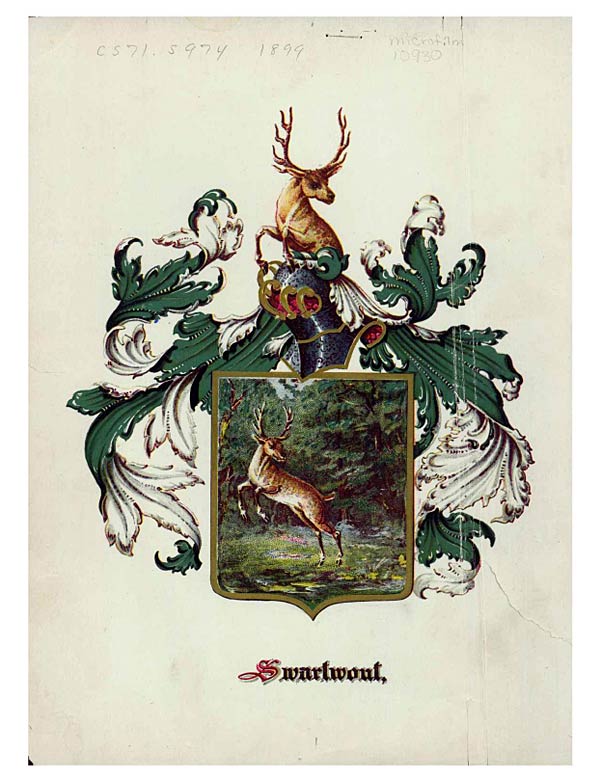
Swartwout Coat of Arms
(Available as prints and more.)

In the first ages of the world people were distinguished by names descriptive of their origin, appearance, traits of character, and by titles derived from imputed blessings of the Diety : Adam (red earth), Cain (gotten from the Lord), Laban (white), Esau (hairy), Jacob (supplanter), Solomon (peaceful), Jonathan (gift of Jehovah), Nehemiah (comfort of the Lord). Later such appellations were frequently bestowed without any consideration of their signification being accepted as denoting the individual’s derivation, features, disposition, or attributes.

Surnames are so called because they were originally written above those first designating mankind. They were then used to denote the vocations, localities of residence, rank, or kinship of the persons bearing them: Faber (Latin, smith), Zimmerman (German, carpenter), Clinton (Dano-Norman, promontory-town), Amherst (Saxon, woodland-village), Sigsby (Anglo-Saxon, town of victory), Prescott (English, priest’s cottage), Luther (German, renowned chief), Johnson (English, son of John). In England and France surnames became hereditary about the eleventh century. As family titles they have been perpetuated mainly by records of sale and purchase of property, by wills, and other instruments of writing.


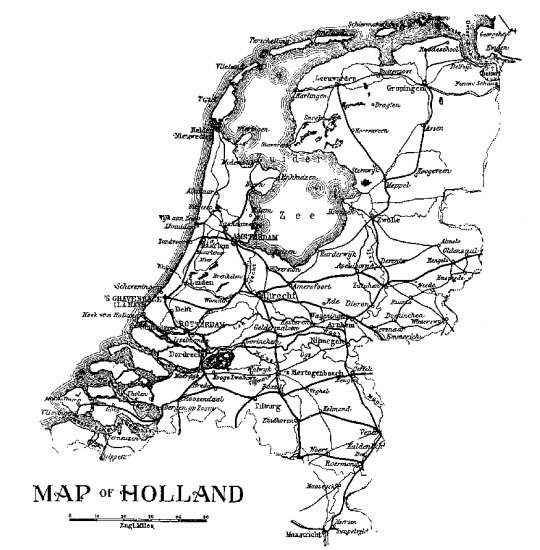
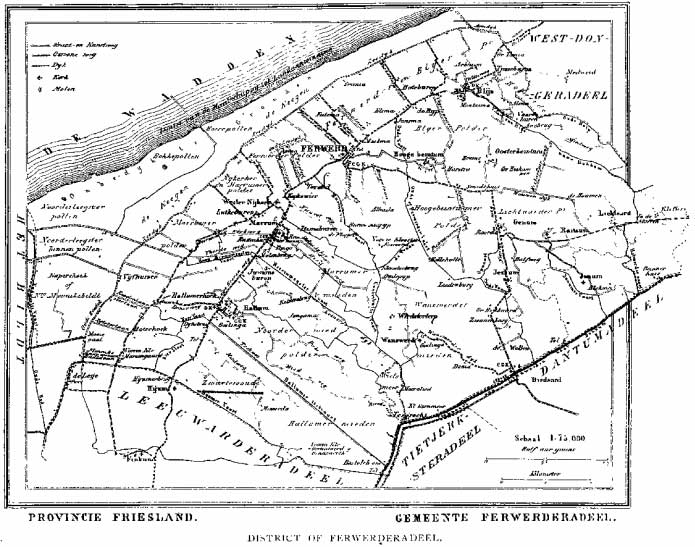
In the middle ages the names of the seats of ancestral estates began also to be used to designate the families possessing them. The appellation Black-wood, derived from a forest-covered demesne in Scotland, has long been the title of a well-known family living in that part of Great Britain. Six centuries ago the synonymous cognomen Swartwout (Blackwood) similarly originated from a densely-wooded manor lying in that part of Frisia or Northern Holland, now known as the district of Ferwerderadeel, in the province of Friesland. A primeval forest, figuratively styled by the inhabitants het Zwartewoude (the Black Forest), then stretched across that part of the Netherlands, north of the city of Leeuwardcn. Now only a few scattered groves diversify the level landscape where formerly the vast wood was imposingly conspicuous. The westward range of this dark forest is still indicated on maps of the province by its early geographical title, Zwartewoude.

Swartwout Chronicles, Chapter 01,  Page 02, Map of Holland
Map of Holland
Swartwout Chronicles, Chapter 01, Page 2

(n.b. Zwarte, also written swarte, a Dutch adjective, meaning black, and agreeing with the neuter substantive woude, also written wout, of the same language, signifying a wood or forest. There is also a Dutch noun, hout, expressing wood or timber as material. The Dutch words woud and hout are closely allied in meaning to the German terms wold or wald, and holt or holz.

Zwartevoude or Zwartewold, the present tract of land bearing that name, is described as lying in the canton of Holwerd, arrondissement of Leeuwarden, districtof Ferwerderadeel, quarter of Oostergoo, in the province of Friesland, bordering northwest on the highway from Hallum to Hallum, northeast on the Hallum canal, southeast on the Hallum meadows, and southwest on the Hallum lake, and having an area of five English acres and certain fractions of an acre. (“Zwartewoude of Zwartewold, streek lands, prov. Friesland, kw. Oostergoo, griet. Ferwerderadeel, arr. Lceuwarden, kant. Holwerd; palende N. W. aan den rijweg van Hijum naar Hallum, N. O. aan dc Hallumervaart, Z. O. aan de Hallumermieden, en Z. W. aan het Hijumermeer, en eene oppervlakte beslaande van 5 bund. 65 v. r. 50 v. ell.”))

Swartwout Chronicles, Chapter 01, Page 04, Province Firesland
Province of Friesland, District of Ferwerderadeel
Swartwout Chronicles, Chapter 01, Page 03

The ensigns armorial or coat-of-arms of the Frisian Swartwouts emblematically represent not only the woody locality of the patrial manor, but also the political freedom which they originally enjoyed as possessors of the extensive estate of Zwartewoude. The right of emblazoning on their war-shields the proper figure of an alert deer bounding across a grassy glade of a dark forest was granted the male members of the family, by royal decree, in the thirteenth century. (n.b. Ecusson: un ccrf sauiant guardant dans line clairere d’une foret noire. Citnier: la tete d’un cerf guardant. Lambrequin: de sinople et d’argent . Vide: Frontispiece.) The inspiring augury, contained in an ancient statute-book of the country, that its inhabitants should be “free as long as the wind blows out of the clouds and the earth remains,” they intrepidly sought to verify by the might of their weighty swords in frequent engagements with foreign invaders, who again and again attempted to put them under subjection.

The Frisians, originally a Germanic race, were already occupying the northern territory of Belgic Gaul when Julius Caesar, in the year 57 8.C., invaded it. They were then far advanced in successful methods of agriculture, and so rich in cattle that they were required by the Romans to pay a heavy tribute in hides and horns. Their fair complexions, bright blue eyes, heavy locks of auburn hair, great stature, and physical vigor, constantly commanded the admiration of the Latin invaders. The men, clad in plainly -made woolen tunics and loosely-fitting breeches, and the women, as simply attired, were so grand in character that they quickly won the respect of the Roman soldiery.

The people of Frisia recognized the existence of God, in whose divine fatherhood they discovered care and guidance, and whom they worshipped in consecrated forests on appointed days. They had no priests and offered no sacrifices. They hallowed marriage; each man exclusively honoring with his affection and fortune the woman chosen for his wife.

The frequent incursions of foreign forces, led by ambitious and depraved commanders seeking to dispossess the inhabitants of Frisia of their property and independence, gradually distempered their minds and morally debased their offspring. It happened in the year 728 that Archbishop Wolfram, of Sens, in Gaul, under the sanction of Charles Martel, or Charles the Hammer, undertook the conversion of the people of Friesland to Christianity. Among those who were willing to be baptized in evidence of their acceptance of the religious teachings of the zealous dignitary was Radbod, a dethroned Frisian king. While waiting to receive the outward sign confirmatory of his faith, his thoughts reverted to his deceased pagan ancestors. “Are they in heaven or hell?” he asked. “In hell,” the pious prelate answered. “Then I would rather dwell hereafter with my kindred there than with a few strange Christians in heaven,” he frankly declared, and forthwith strode away from the surprised archbishop.

Poppo, the son of Radbod, who succeeded him in governing Friesland, was killed in 750 in a battle with Charles the Hammer, who established at Utrecht the famous episcopate of which Saint Willebrordus was the first…

CONTINUED: Chapter 01 pp 5-8 Frisian Ancestors